Flying to Korea for AGF Korea 2026? Here’s the short version: the festival runs December 4–6, 2026 at KINTEX Exhibition Center 1 in Ilsan, and the fastest way in is the GTX-A train from Seoul Station, about 16 to 17 minutes door to platform.

This guide covers the KINTEX map, the GTX-A route, every other way to reach the venue, where to sleep nearby, and what it’ll actually cost you in US dollars. No fluff, just what you need to plan the trip.
What Is AGF Korea 2026

AGF, short for Anime X Game Festival, is Korea’s largest subculture festival. It’s held every December at KINTEX in Goyang, and 2026 marks its seventh year running.
AGF 2026 takes place December 4 through 6, occupying Halls 1 through 5 of KINTEX Exhibition Center 1. The event is hosted by ANIPLUS, DAEWON MEDIA, Sony Music Solutions, and D&C Media, with the venue confirmed back in June 2026.
Last year’s edition was a milestone. AGF 2025 drew 100,518 visitors, surpassing the 100,000 mark for the first time in its history, a growth of roughly 40% compared to the previous year. That’s the scale you’re walking into.
The 2026 key visual features Shaya, the festival’s mascot, now framed as a “Festival Navigator” guiding attendees through stages, merch booths, collaboration cafes, and exhibitor halls. Early exhibitor registration opens July 15.
One thing worth knowing before you pack your cosplay bag: KINTEX has tightened its rules around photography and costume shoots in shared lobby spaces in recent years, mostly to keep walkways clear during high-traffic events. Check the official AGF notices closer to the date for the current policy.
KINTEX Map: Finding Your Way Through Halls 1–5
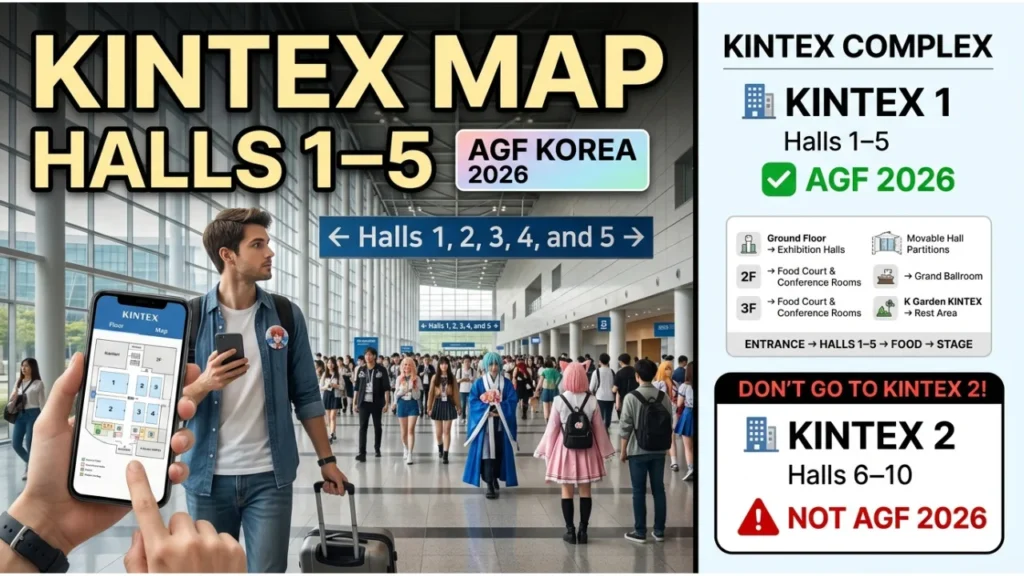
KINTEX actually has two buildings, and mixing them up is the single most common mistake first-timers make.
KINTEX 1 holds Halls 1 through 5. KINTEX 2 holds Halls 6 through 10. AGF 2026 is entirely inside KINTEX 1, so that’s the building you want. A moving walkway connects the two buildings, but don’t rely on hall numbering alone to guess which one you need.
Inside KINTEX 1, the layout breaks down roughly like this: the ground floor holds the exhibition hall entrances, a small-business permanent exhibit space, and the K Garden KINTEX rest area near Hall 5A. The second floor has a food court and conference rooms. The third floor holds the Grand Ballroom, used for concert-style stage programming and banquet events.
Each hall in KINTEX 1 uses movable partitions, meaning the space can expand or shrink depending on how many halls an event books. For a festival AGF’s size, expect all five halls, plus overflow into lobby and conference spaces for smaller panels or meet-and-greets.
Practical tip: screenshot the official KINTEX floor plan before you land. Cell signal inside a packed exhibition hall isn’t reliable, and paper maps at the door run out fast during peak hours.
GTX-A Route to KINTEX: The Fastest Way From Seoul

If you remember one fact from this guide, make it this one: GTX-A cuts the Seoul-to-KINTEX trip down to about 16 minutes, compared to over an hour on the old subway-and-bus combo.
Here’s how the route actually works. GTX-A runs on a separate, deeper platform from Seoul’s regular subway lines, marked with gold signage rather than a colored line number. Don’t assume it’s just another exit off the Line 1 or Line 4 platforms, budget a few extra minutes the first time you look for it.
From Seoul Station, the ride to KINTEX Station takes roughly 16 to 17 minutes, one stop past Daegok. Exit at Exit 1, and you’ll walk directly toward the KINTEX 1 entrance, passing the Hyundai Motorstudio building along the way.
GTX-A fare from Seoul Station to KINTEX Station runs about ₩4,200 one-way, which converts to roughly $3 USD at current exchange rates. A regular T-money card works fine, tap in, tap out, same as any subway ride. You can grab one at almost any convenience store near a station.
This segment of GTX-A has been running since late December 2024, so it’s a stable, fully operational line, not the still-under-construction middle section some older articles warn about.
Transport Options Beyond GTX-A: Bus, Taxi & Airport Routes

GTX-A isn’t your only option, and depending on where you’re staying, it might not even be your fastest one.
From Incheon International Airport, the most straightforward path is the AREX airport train to Seoul Station, then GTX-A onward to KINTEX Station. Budget roughly two hours door to door once you factor in immigration, baggage, and the connection. Direct airport limousine buses to KINTEX also run, useful if you’d rather skip a transfer.
Buses connect KINTEX to several Seoul hubs. Routes from Gangnam, Yeongdeungpo, and Gimpo Airport all serve the area, though you’re at the mercy of traffic, which matters a lot on a festival night.
Taxis take about 30 to 40 minutes from central Seoul in normal traffic. Fine for the ride in. Less fine for the ride out, since a crowd leaving KINTEX after AGF wraps for the day creates the same taxi-queue chaos you’d expect after any major event.
Here’s the part most guides skip: plan your route home before you leave your hotel, not after the last panel ends. GTX-A’s last train from KINTEX toward Seoul runs around 12:42am. Local buses connecting nearby stations to Seoul typically stop between 10:40pm and midnight. If your evening plans run late, know your cutoff time in advance.
Hotels Near KINTEX for AGF Korea 2026
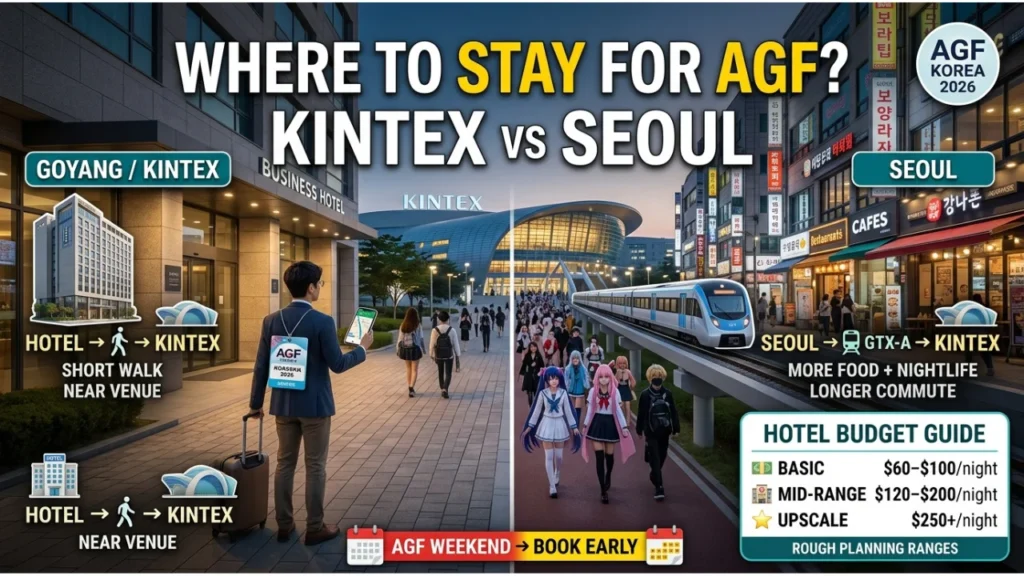
Where you sleep depends on whether you value a short walk or better food and nightlife.
Staying in Goyang, close to KINTEX itself, means a five-to-ten-minute walk to the venue each morning. Hotel options directly near the exhibition center are limited in number, think a few hundred rooms total across nearby properties, so during a 100,000-visitor weekend, they sell out early. Book as soon as your AGF dates are confirmed.
Staying in Seoul trades a longer commute for far more restaurant, nightlife, and shopping options, with GTX-A making that commute genuinely painless at 16 to 17 minutes each way.
For a rough budget picture: expect $60 to $100 USD a night for a basic business hotel near KINTEX or in outer Seoul, $120 to $200 USD for a solid mid-range stay closer to central Seoul neighborhoods like Hongdae or Myeongdong, and $250-plus for upscale properties with better amenities.
Whichever you choose, book AGF weekend accommodation months out, not weeks. Korean convention-city hotel inventory is small compared to the crowd size these festivals now pull in.
Budget & Transport Costs for US Visitors

Here’s what a realistic AGF trip costs, broken into pieces.
Daily transport: if you’re commuting from Seoul each day, figure two GTX-A rides at roughly $3 each, so about $6 a day just for the train. Add a few dollars for local subway or bus connections and you’re looking at $8 to $12 a day in transit costs.
A sample 3-day AGF budget, covering transport, a mid-range hotel, meals, and festival admission, lands somewhere around $500 to $800 USD for a solo traveler, not counting flights or merchandise spending, which for a festival this size can add up fast.
Currency tips: a T-money card covers trains, subways, and buses everywhere in this guide. Most US credit cards with no foreign transaction fees work fine at hotels and larger shops, but carry some cash, roughly $50 to $100 USD equivalent in won, for smaller vendors, food stalls, and festival merch booths that may be cash-only.
FAQs
What is the GTX-A line in Seoul?
GTX-A is a high-speed regional express train connecting Seoul’s northern and southern suburbs through downtown at much faster speeds than the regular subway. The Seoul Station to KINTEX Station segment has run since late 2024 and cuts a formerly hour-long trip down to about 16 minutes.
What is GTX in South Korea?
GTX, or Great Train eXpress, is Korea’s new metropolitan express rail network, built to connect Seoul’s outer suburbs to the city center far faster than existing subway lines. Several GTX lines are planned or under construction; GTX-A is the first to open sections to the public, including the KINTEX stop.
Is KTX or SRT better?
KTX and SRT are both Korea’s high-speed intercity rail services, running on largely the same tracks between major cities like Seoul, Busan, and Daegu. SRT tends to run slightly cheaper and departs from Suseo Station rather than Seoul Station, which matters if you’re staying in southern Seoul. Neither is objectively “better,” the right pick depends on which station is closer to your hotel and which schedule fits your trip.
How much is a train ticket in Korea?
It depends heavily on the line and distance. A GTX-A ride from Seoul Station to KINTEX runs about ₩4,200 (roughly $3 USD). Regular subway fares within Seoul start around ₩1,400 to ₩1,800. Long-distance KTX tickets between Seoul and Busan run $40 to $60 USD, depending on class and how far ahead you book.
How much money to bring to Korea for 7 days?
For a 7-day trip covering a mid-range hotel, meals, local transport, and some shopping, budget roughly $900 to $1,400 USD, not including international flights. Attending a festival like AGF adds ticket and merch costs on top of that baseline.
How expensive is public transport in South Korea?
South Korea’s public transport is inexpensive by US standards. A standard subway or bus ride in Seoul costs under $1.50 USD, and even the newer, faster GTX-A line runs only a few dollars per trip. A T-money card loaded with $20 to $30 USD comfortably covers several days of regular commuting.
Conclusion
AGF 2026 is shaping up to be Korea’s biggest subculture festival yet, and getting there is easier than most guides let on. GTX-A turns what used to be an hour-long slog into a quick 16-minute hop, KINTEX 1’s Halls 1 through 5 are straightforward once you know the layout, and a modest daily budget covers transport without stress.
Book your hotel early, screenshot the venue map, and know your last train home before the crowds hit the exits. That’s really all the planning this trip needs.

Abroy John is the Founder and Editor of Asia Pop Fests, where he covers
entertainment news and events from across Asia. He focuses on accurate,
up-to-date reporting on the region’s festivals and pop culture.